
I visited a church recently where the man that was preaching spoke about how all things belong to the Lord and how we need to be a good steward of what the Father has blessed us with. His message was, overall, very good. However, there was a part that stuck out the most and has been with me for over a week now. I know the Lord was speaking to me because all I wanted to do was sleep last night and was so ready for bedtime, but the message kept rolling in me.
The man made a statement saying, ‘Someone needed to borrow my truck, so I lent it to them. When they brought it back it was damaged and I had to save up money to have it repaired. The Lord provided the finances and we got the truck fixed. Now when the person brought back the truck I never said anything to them about the damage, I never said anything at all.’
‘I never said anything at all.’ This stood out to me so strongly. I thought to myself, ‘Well that’s contradictory! Isn’t it?’ He is speaking about being a good steward yet allowed what the Father had blessed him with to be abused. While preaching stewardship he, at the same time, is allowing his own flock to walk away without consequence. That, to me, is very contradictory.
As this was rolling through me last night, six days after hearing the message, two hours tossing and turning about the Lord’s response to it, I have come to this conclusion:
So many take biblical verses at face value, they give it no more thought, questioning and researching nothing, as well as forgetting the context. We must always remember context IS key! Here are the Bible verses he is basing his action off of:
Give to everyone who begs from you, and from the one who takes away your goods do not demand them back.
Luke 6:30 ESV
And if anyone would sue you and take your tunic, let him have your cloak as well. And if anyone forces you to go one mile, go with him two miles. Give to the one who begs from you, and do not refuse the one who would borrow from you.
Matthew 5:40-42 ESV
As the Lord did so often in the gospels, he spoke with extreme offense, his statements were amplified. They were magnified in such a way he made sure everyone knew they had fallen short. His goal was to make sure we understood the consequences to our actions as well as the importance of righteousness.
Now, these verses, which I am very confident the teacher was basing his actions off of must be put in context. The two verses above are part of the, ‘Sermon on the Mount,’ where Jesus first spoke about the beatitudes. He starts his sermon by saying, ‘Blessed are the poor in spirit.’ Matthew 5:3 We now know that the said verses were not a single statement but part of a much larger and powerful message.
He goes on saying nine different times, ‘Blessed are…’ and the last one he says is, ‘Blessed are you when others revile you and persecute you and utter all evil things against you falsely on my account. Rejoice and be glad, for your reward is great in heaven, for so they persecuted the prophets before you.’ Matthew 5:11
In this same Sermon, on the same day, he goes on and says, ‘You are the salt of the earth. You are the light of the world. I have not come to abolish the law, but to fulfill it.’ He also compares murder to anger and lustful thoughts to committing adultery against your spouse. He then says,
‘If your right eye causes you to sin, tear it out and throw it away. For it is better that you lose one of your members than that your whole body be thrown into hell. And if your right hand causes you to sin, cut it off and throw it away. For it is better that you lose one of your members than that your whole body go into hell.’
Matthew 5:29-30
After that grotesque statement Jesus then makes the remark about lending and not asking back, letting the perpetrator slap the other cheek and to love your enemy.
Here is my question to the speaker, ‘Speaker! Why do you have your eyes? And why do you have your hands?’
If we are to take the Bible literally (and most importantly out of context) then we must take the entirety of it in such a way!
The Bible isn’t a book. It may appear so to us, but the reality of it is that what we have is a compilation of letters written to churches, sermons written down, historical documents passed down from generation to generation.
Let’s create a hypothetical, we will say over a 100 generations ago a family member documented their journey starting with establishing a home, family and trials they suffered through. That documentation was passed on to the next generation, now this generation lived an entirely different life, they may have gone through famine or war, who knows, they could have even been anointed king. This repeats over and over until it gets to us, it’s a compilation of history, letters to loved ones and teachings.
This is pretty much the Bible. It is not a random book, it is a compilation of historical documents. The evidence and confirmation that cannot be destroyed is overwhelming. The thing is we only have one sided views and only parts of letters. We also didn’t live in the same time frame. The way people operated back then isn’t remotely the same as now. That means sayings, rituals and so much is very different than today’s times.
Here is an example of times changed, an example of what is no longer practiced:
When Jesus spoke the Sermon on the Mount he said, ‘And if anyone forces you to go one mile, go with him two.’ Matthew 5:41
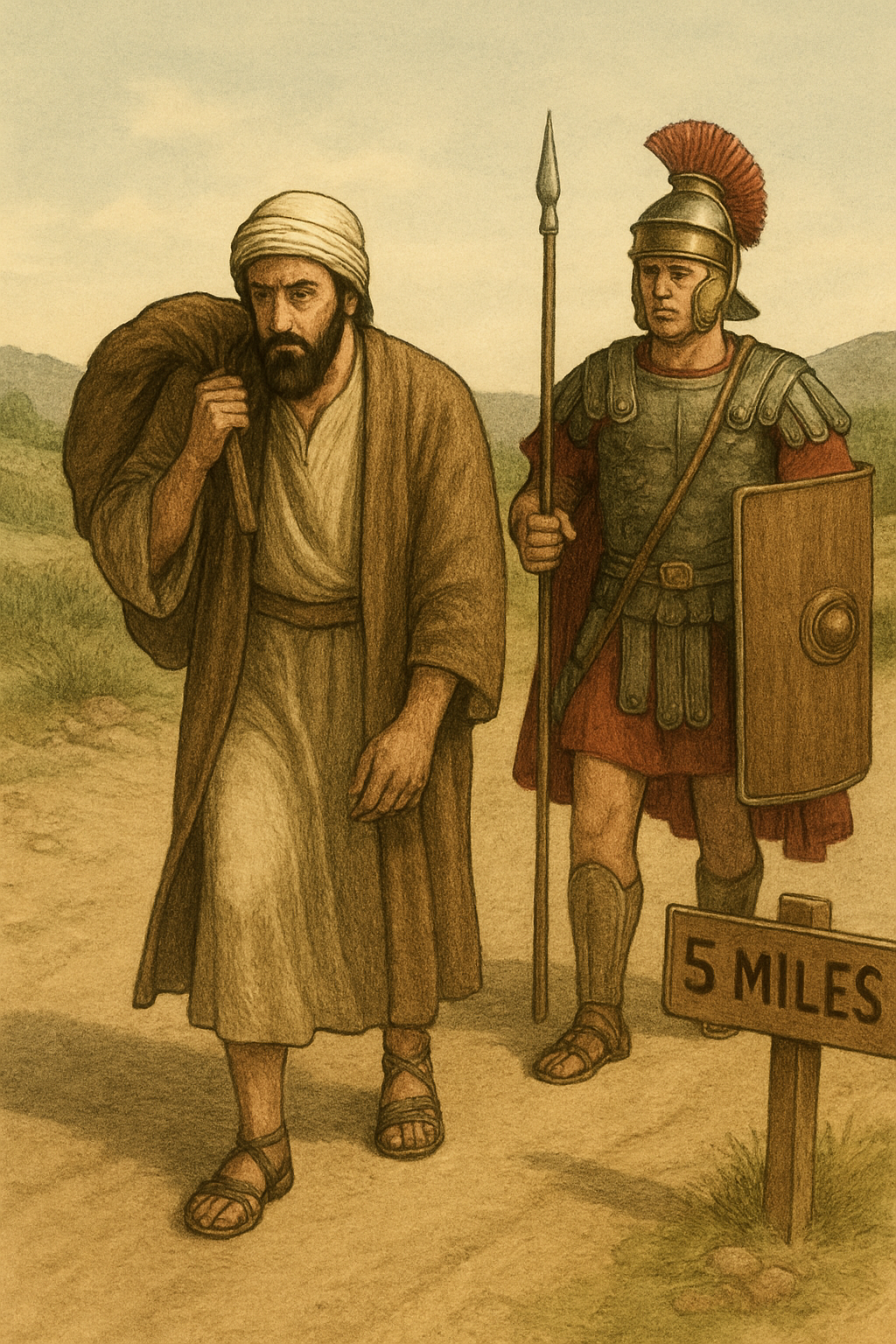
This was a Roman law. The Roman soldiers were allowed, with legal authority, to requisition manual labor from the civilians for transportation. It was a reminder that they were conquered by the Romans and to know their place.The Roman mile was 4,854 ft. In today’s mile it is 5,280 ft. So once again we can see the difference in today’s time versus theirs.
Did you know on the Sabbath day the Jews were only to go a ‘Sabbaths day journey’ which consisted of 3,000 ft.
Now can you imagine the Roman’s forcing the Jews to break their own laws for Sabbath by forcing and humiliating them, to carry the conquerors burdens as well as making them walk an extra 6,708 ft (there and back) ultimately breaking their law and forcing them to commit to walking no further that day. I can only imagine the disdain towards the Roman’s in that time.
Jesus changed their way of thinking, and he empowered the Jews. First the Jews were forced, now the Jews do it willingly and even will go an extra mile, leaving a mark forever in the hearts and minds of the soldiers. This was law. This was meant to dehumanize and humiliate the civilians and Jesus turned it around and made it into something to find joy in by becoming a willing vessel, one that will go the extra mile. How marvelous is that!
We can certainly see how much of a difference then verse now makes. The Father knows what he is doing, much better than us.
Let’s address one more thing before we close here; Luke 6:30, ‘give to anyone who begs from you.’
The key word is ‘begs.’ The one who truly in need. Discernment is so important in our spiritual walk. There are times when the Father is saying, ‘Go the extra mile,’ and times when the Father is saying, ‘You’ve done enough.’ That discernment comes from our heart, that gut feeling-the Holy Spirit. Listen to it.
“And I will give you a new heart, and a new spirit I will put within you. And I will remove the heart of stone from your flesh and give you a heart of flesh. And I will put my Spirit within you, and cause you to walk in my statutes and be careful to obey my rules.”
Ezekiel 36:26-27 ESV
There is a time to bring the shock of:
‘Whoa! I cannot believe they didn’t react to me with malice.’
‘Whoa! I cannot believe they are doing even more than I asked-even knowing that I am taking advantage of them.’
And a time to say:
‘If you do not work, you do not eat.’
2 Thessalonians 3:10
Take a breath. Ask the Lord how you’re supposed to respond, listen and feel the direction of the Holy Spirit. Not everyone is supposed to get that extra mile or keep what has been lended to them or take all that you are wearing. We absolutely MUST at all times ask and listen to the Holy Spirit. He will never lead you astray!
He desires us to honor what he has blessed us with and to not lend to those whom will destroy it. What good father would want to bless us with more if we do not value what he has already blessed us with?
And remember, context IS key-and so is historical context.